
Schlehdorf sets a precedent: How a student project became a model for Munich, Luton and Costa Rica
At the first Munich Climate Week on October 21, 2026, students from the St. Immaculata secondary school in Schlehdorf presented their solar project. They did everything themselves, from measuring the roof to organizing the fundraising. And the project has since inspired three other schools.

An evening at Schnitzer& Studio
Munich Climate Week took place for the first time in 2026, with over 300 partner organizations and more than 300 events throughout the city. Solar Education participated with two formats: the workshop "Hands-on Climate Education" for teachers at the Max-Josef-Stift Gymnasium and the lecture "Schools Powered by Electricity" on October 21st at Schnitzer& Studio on Lindwurmstrasse.
The students themselves presented the evening's presentation: Ludwig, Beni, Kilian, Leon, Lena, Antonia, Marlene, and Isa from the St. Immaculata Archbishop's Realschule in Schlehdorf. Five classes from grades 8 to 10 are participating in the project, all on a voluntary basis. The eighth graders are handling the technical aspects, the ninth graders the costs, and the tenth graders sponsorships, permits, and public relations. The entire project is overseen by physics teacher Manfred Gödel and deputy headmistress Sylvia Geiger.
The recording of the presentation is available on our YouTube channel: School under electricity, part 2 .
Laudato Si and climate change on our doorstep
The opening was unusual: a song. Every child at a Catholic school knows "Laudato Si" from their religious education classes. The students explained its meaning: the Canticle of the Sun by Francis of Assisi, written 800 years ago, and Pope Francis' encyclical on caring for our common home, published in 2015 shortly before the Paris Climate Conference and scientifically reviewed by Hans Joachim Schellnhuber. At that time, the 1.5-degree target was agreed upon. Today, the students pointed out, we are significantly exceeding that.
Beni explained what this means in concrete terms. He comes from a farm and notices the changes every year: dry periods in June and July, parched soil, a poor third grass cutting, rust disease in clover, and falling water levels in streams and lakes. His conclusion: climate change must be slowed down, and that's why he thinks the project is the right one.
How it all began
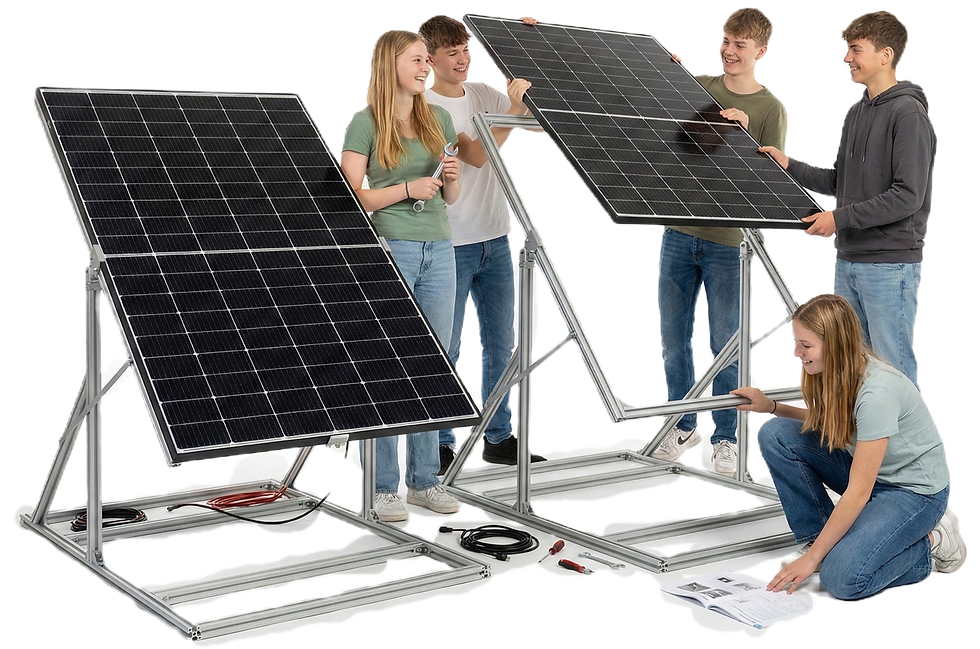
It all started with a solar kit. Sister Josefa Thusbaß, former headmistress and physics teacher, established contact with the solar education program, and the Dominican missionary nuns from the neighboring convent donated one of our experiment kits to the school. In their elective electronics class, the students used it to install two small modules on the school grounds and came in second place in the Raiffeisenbank's Energy Heroes competition. The pilot system, with its hybrid inverter and two batteries, now powers a mobile phone charger and a camera in a birdhouse.
Then came the sentence that made everything bigger. Leon, then in 8b, said: "We can build that ourselves." Four students from 8b, Kilian, Benedikt, Leon, and Ludwig, initiated the idea without involving the school administration. Matthias Schmuderer from Solar Education agreed to support the project. The project kicked off in December 2025, during the school's year of sustainability.
The investment in figures
The school building is a listed historical monument, and the gymnasium roof is too large for a student project. So, the caretaker's shed right in front of the school was chosen: easily accessible and sunny. The students measured the roof themselves during class. There was no ladder, but they did use the Pythagorean theorem. The result: approximately 60 square meters.
Leon presented the technology:
14 modules, each with 455 Wp, on both sides of the roof, totaling 6.3 kWp
Power is supplied to the neighboring gymnasium via existing pipes.
Roof pitch and solar radiation calculated for each side of the roof, including shade cast by a tree.
The gymnasium consumes around 10,000 kWh per year, while the system realistically delivers about 5,000 kWh, with strong peaks in summer and little in winter.
Savings: approximately 3,000 kg CO₂ per year, as much as 17 mature trees absorb.
The students did the math: modules, substructure, inverter, meter, battery, and installation together cost around €13,500. Through feed-in tariffs for surplus summer electricity and the savings on purchased electricity, the system pays for itself after about nine years.
Donations, permits, press
The question remains: where did the money come from? The tenth-grade classes at the time launched a fundraising campaign, writing to companies, sending emails, and making phone calls. They also learned a valuable life lesson: a period was missing from the email address they provided, and Ms. Geiger spent about four weeks on the phone until roughly €2,000 in donations resurfaced. Small mistakes, big impact.
In the end, the Dominican Missionary Sisters and the Schlehdorf Monastery, as educational partners, provided crucial support, along with a crowdfunding page and Ms. Geiger herself. The project didn't cost the school authority a single cent. The school was featured twice in the newspapers at the beginning of 2026, in the Süddeutsche Zeitung and the Gelbes Blatt . Student Manuel summed up the project perfectly in the latter: "School with a difference."
All permits and approvals have now been granted, including those that took some time to obtain. Work begins in March. Then the students themselves will climb onto the roof and assemble the modules during class time.
From pilot project to model
Finally, Matthias Schmuderer took the floor and brought some news. The project in Schlehdorf is not only a first in Germany, it has become a catalyst. The newspaper photo of the students and an article about the petition project in the journal Unterricht Physik (issue 213/214, "Climate Change: From Understanding to Action") convinced supporters that the idea works. What Schlehdorf painstakingly raised through donations is now being provided to other schools as start-up funding.
The experiences from Schlehdorf have also been incorporated into our teaching unit: Project Development of a Photovoltaic System , for students from 8th grade onwards, 2 x 90 minutes. We have adapted and expanded it so that it now covers all phases of project development. Working as a project team, the students plan a PV system for their own school, from choosing the location and determining electricity demand to assessing economic viability, obtaining permits, and even submitting a petition to the relevant authorities. The unit can be used as a single lesson or as the starting point for a project that the school then actually implements.
Three schools have since started their own youth-led solar project:
the European School Munich
Lealands High School in Luton, England
the Colegio Humboldt, the German School in Costa Rica
These three projects are funded by ServiceNow via the ChangeX platform. Google is funding the next rounds: In Sweden, the call for proposals has just ended with five applications, including two schools, two sports clubs, and a youth association focusing on nature and agriculture. Austria will follow. Details about the funders and the participating regions can be found on our Youth-led Solar page .
He thanked the students who said: We'll do this now. And he thanked Martin from Schnitzer& Studio, who provided the space.
Youth-led Solar: How schools can participate
Our Youth-led Solar program grew out of the pilot project in Schlehdorf. Students develop their own photovoltaic system, from the initial idea and technical planning to financing and evaluating the electricity generation during operation. Teachers provide guidance, but the class makes the final decisions. Solar Education supports the program with kick-off workshops for teachers and students, either on-site or online, and with project coaching during implementation. Funding for this program is available in some regions through ChangeX.
Anyone considering installing their own solar power system at their school can find all the information on our Youth-led Solar page or contact us directly.
To read more
A first in Germany: Students in Schlehdorf are setting up their own photovoltaic system (Press release, October 1, 2026)
Schlehdorf students want to generate solar power (Süddeutsche Zeitung, March 26, 2026)
“School with a twist”: Schlehdorf secondary school students launch pilot project (The Yellow Pages, April 11, 2026)
Kick-off for our solar project in the Year of Sustainability (Realschule Schlehdorf, December 2025)
Physics Lessons, Issue 213/214: Climate Change, from Understanding to Action (Friedrich Verlag, 2026, with the article “Petition Project for a School Photovoltaic System”)


Comments