
Rwanda: Our teaching materials in Africa for the first time

In the yard of the Muhabura Integrated Polytechnic College in northern Rwanda, 29 trainees in blue overalls stand around an aluminium frame. 14 young women, 15 young men, all studying electrical engineering. In front of them lies a solar module, next to it screws, cables, a switch box. Inside the classroom stand the stations of the PV Science Kit, where they spent the morning measuring current-voltage curves and searching for the best tilt angle. By the end of the morning the system is standing, the module is tilted towards the sun, and for the first time the switch box carries electricity they have generated themselves.
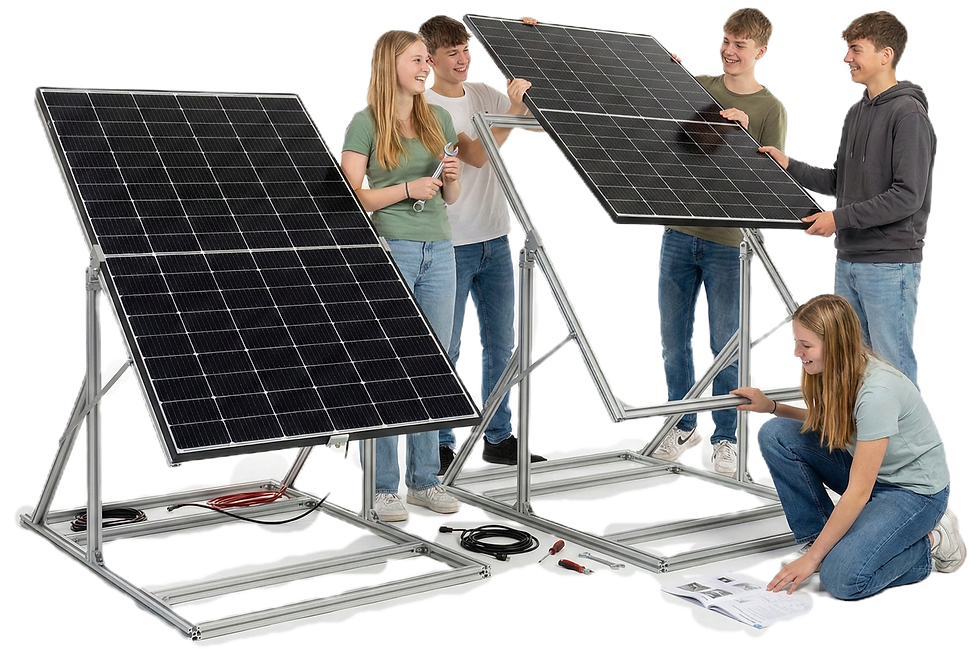
We know both of these well. They are our Educational PV System and our PV Science Kit, built at the Caritas Brucker Werkstatt in Fürstenfeldbruck, some 6,000 kilometres away. That they are in use in Musanze that day was not an idea from our office. It is the story of a small association that bought two teaching kits and brought them to Rwanda: the science kit as a parcel, the PV system with considerably more effort.
An association with a plan
Rediscovering Rwanda e.V. is a German non-profit association that supports education and development projects in Rwanda. Gaspard Ngarambe and Joseph Iradukunda, who run the project, had made a clear observation: solar energy is taught at the country's technical and vocational schools, but almost only on the blackboard. There is little equipment to get your hands on, and hardly any money to buy it. Yet solar power is the obvious energy source for rural regions without a stable grid connection, and the sector is looking for skilled people.
Their answer was called “Power2Learn – Mobile Solar Workshop”: a set of training equipment that can travel from school to school, and a multiplier approach in which teachers are trained first and then pass their knowledge on to colleagues and students. For the equipment, they came to us. The association bought a PV Science Kit and an Educational PV System, the same teaching materials that schools in Bavaria, Ireland or Wales work with. We became the cooperation partner; the local partner on the ground is the organisation CPR.

On 8 November 2025 we met in Munich for the handover. A day of introduction to the experiments, assembling and dismantling the system, questions about transport and maintenance. Then the equipment set off on its journey, and that was anything but simple. The science kit is the easy part: four boxes of twelve kilos each, which can be sent anywhere by parcel service. The PV system, with its frame, base, table and switch box, weighs so much that transporting it became the real logistical task of the project. The solar modules themselves stayed in Germany, too bulky for the trip. Rediscovering Rwanda sourced them locally in Rwanda, which incidentally shows that our system works with standard off-the-shelf modules wherever it stands.
From Kigali to Musanze
Six weeks later, on 18 and 19 December 2025, the system stood in the Isano Training Center in Kigali. 14 teachers from technical and vocational schools had come, along with three project managers from the partner CPR and two solar experts from research and academia. For two days they worked through the four experiments of the PV Science Kit: How does the yield depend on the tilt angle? What happens when you connect cells in series or in parallel? Where is the maximum power point? What makes a good cell? Then the teachers built the system themselves for the first time, using the same instructions used in Bavaria.
The photos from Kigali show what we know from German classrooms: people bent over a worksheet in discussion, three of them holding a cross brace, eyes on the meter as the module is turned towards the sun. That the worksheet is in English and the hills of Kigali lie outside the window changes nothing.

On 31 March 2026 came the third step, in Musanze. Now the trained teachers were teaching themselves. With the 29 trainees of the Muhabura Integrated Polytechnic College they went through the experiments, assembled and dismantled the system, recorded measurements and evaluated them. Added to this was an introduction to the installation, operation and maintenance of PV systems, exactly the trade these young people will later practise. For many of them it was the first time they had held a solar system in their hands rather than seeing it in a textbook.
What remains

After the workshops in Kigali and Musanze, Rediscovering Rwanda surveyed the participants. For us the result reads like a report card: all participants see solar energy as the key to powering rural regions, the large majority want to build their knowledge further, and both the science kit and the PV system were rated as highly effective teaching and learning tools. The schools involved want to use the equipment in their lessons permanently.
The report also names the hurdles, and we think it is right not to gloss over them. Most technical schools in Rwanda cannot afford equipment like this, and access to modern experimental equipment remains limited. A mobile system that travels from school to school is a clever answer to that, but it is still a single system.
So the partners have agreed on how to continue: raise further funds for additional equipment, expand the cooperation between schools, experts and project partners, and keep passing the knowledge on through the trained teachers. And one point that pleases us in particular: they are looking into whether individual components could in future be manufactured and assembled in Rwanda itself. A teaching kit that was born in a workshop for people with disabilities in Upper Bavaria could become the model for a workshop in East Africa.
That we are only writing about this now has a simple reason: the project report from Rediscovering Rwanda reached us recently, and we wanted to tell the story with the figures, photos and feedback it contains, not beforehand and from a distance.
Why this story means so much to us
We developed our teaching materials for schools in Germany, and we never thought of them as development aid. All the more moving, then, that an association decided on its own initiative to take exactly these materials to Rwanda, because they solve a real problem there. It confirms something we have believed since the day we started: a solar system you build with your own hands is understood equally well anywhere in the world. Physics needs no translation.
And it shows what our teaching materials can do when you let them travel. The same system that led pupils in Schlehdorf to plan their own photovoltaic installation prepared future electricians in Musanze for their profession. Our thanks go to Gaspard Ngarambe, Joseph Iradukunda and the whole team at Rediscovering Rwanda e.V., to the partner CPR, to the teachers who took on the experiment, and to the 29 trainees in Musanze who showed us how far an idea can travel.
Do you know an organisation that would like to bring our teaching materials to a place where they are needed? Or would you like to help the next system get to Rwanda? Write to us at kontakt@solarbildung.org.
Project report: Gaspard Ngarambe and Joseph Iradukunda (Rediscovering Rwanda e.V.), June 2026. Photos: Rediscovering Rwanda e.V.

Comments