
Schlehdorf students want to generate solar power - SZ press article
By Petra Schneider, Süddeutsche Zeitung, March 26, 2026

Just do it: Girls and boys from the Schlehdorf secondary school are building a photovoltaic system on the roof of the school garage on their own responsibility.
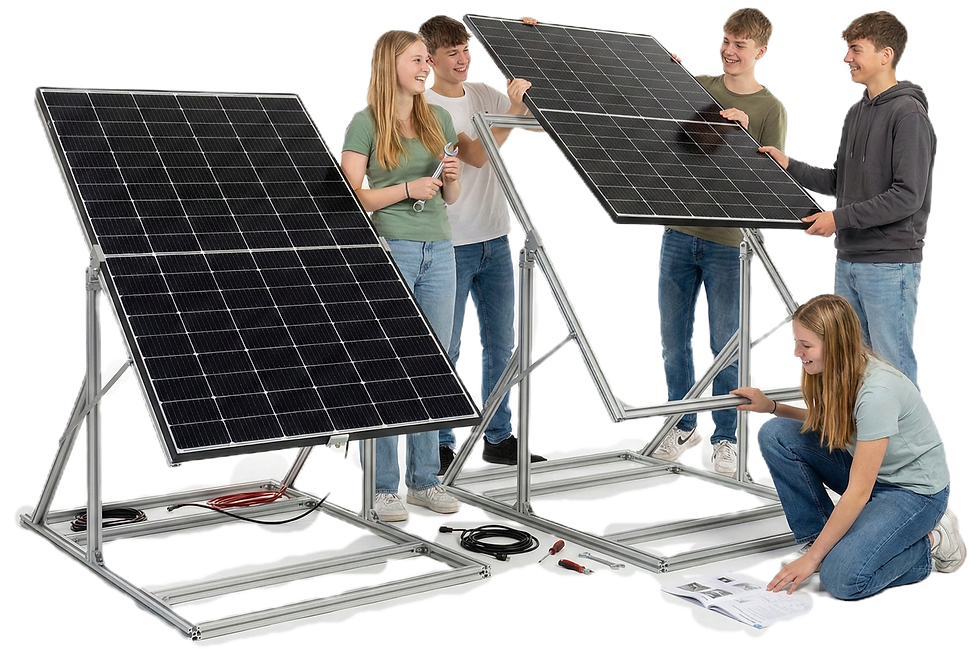
It all started with a solar research kit: On a sunny morning, students from the St. Immaculata Archbishop's Realschule stood on the roof of the school's annex and demonstrated how a small propeller could spin using only solar power. The experimental setup, provided by the company Solar Bildung, was a gift from Sister Josefa Thusbaß. "We need the energy transition," explained the former headmistress and physics teacher. She was pleased that the students could actively participate with these learning materials. "Especially the girls," emphasized the Dominican missionary nun. Her gift had a lasting impact; the small propeller experiment wasn't the end of it for the young people. They had bigger plans: They wanted to install a photovoltaic system on the school's garage roof, which would cover half of the gymnasium's electricity needs.
“We thought it would be cool if we could set this up on a larger scale,” says 14-year-old Leon. Five classes from grades eight to ten are participating, with roughly equal numbers of girls and boys volunteering. A trial run has already been completed: Two solar panels have been installed on the roof of the school extension. Cables run to the ground floor, concealed behind a white wooden partition under the stairwell. A hybrid inverter converts the solar direct current into alternating current and stores excess energy directly in two batteries. The generated electricity can also be used immediately: Charging cables for cell phones are available in a wooden box. The camera, installed in a nesting box on the school roof, is also powered by the school's own electricity.

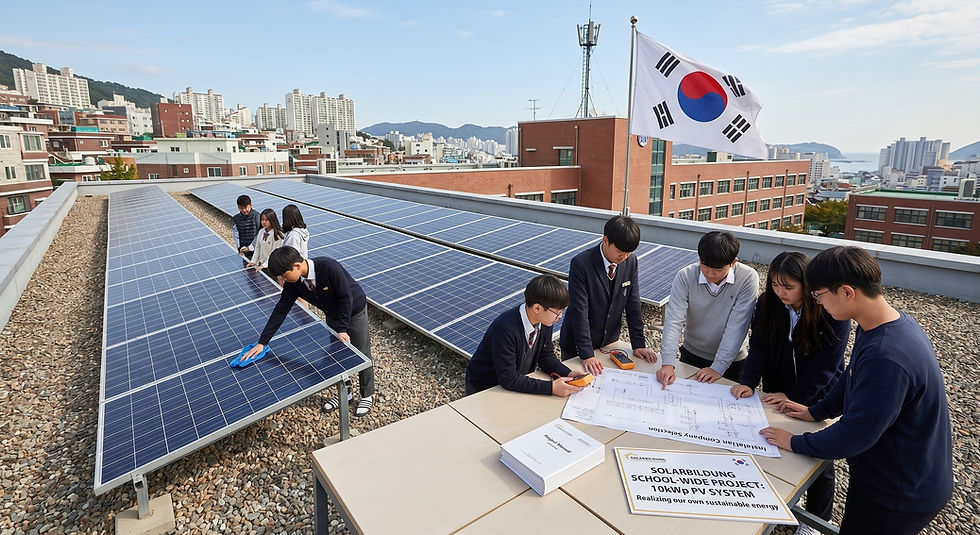
The students proudly recount their successful pilot project; if all goes according to plan, the large photovoltaic system will be installed on the garage roof this summer. From planning to implementation, the students are handling everything themselves, with each grade level focusing on a different aspect: technology, economic viability, fundraising and public relations, coordination, and installation. Because the school building is a listed historical monument and the gymnasium roof is too large for such a school project, they chose the garage as the location. The land belongs to the Dominican nuns, and the building to the Archdiocese of Munich, which is the school's sponsoring organization.
The roof will be fitted with a total of 14 photovoltaic modules on both sides, which should cover about half of the gymnasium's electricity consumption. The modules will be supplied by a partner of Solar Bildung and installed together with the students. They have calculated the investment costs, including installation and battery, at around €13,500, which should pay for itself in just under six years. "We want to do something for climate protection," explains Manuel. And in a very practical way, because schools can do more than just impart theoretical knowledge. "Just do it," says the eighth-grader.

His classmate Maria adds that their photovoltaic project could reduce the school's electricity costs. Her group is currently filming an explanatory video that will be linked on the school's website. They hope to inspire other schools and get them excited about the project.
This is also the mission of Solar Bildung. Since 2020, the Munich-based non-profit organization has been committed to bringing sustainable education to schools. Learning materials and experiment kits are developed by a team of volunteers and scientific advisors, including astrophysicist Harald Lesch. Last year, according to the certified "common good company," 200 schools in Germany, Austria, England, and Ireland were equipped with learning materials, reaching around 15,000 students. It also received the national UNESCO award for "Education for Sustainable Development." "Young people often only hear bad news," says Managing Director Mike Marqués. His company wants to spread more optimism and show young people that they themselves can make a difference. "And thus transform powerlessness into confidence."
Sponsors and the approval of the archdiocese are still needed.
The project isn't about maximizing electricity production, but rather about the students taking on as much responsibility as possible, emphasizes Manfred Gödel, a science teacher at the Schlehdorf school. This includes learning from mistakes and having confidence in themselves. "For example, writing a letter to the local council and the district administrator." The students have already gained some experience: how difficult it is to find sponsors. The money isn't there yet, says Leon. And they haven't received approval from the Archdiocese. That's the next step. "We want to go to Munich before Easter and present the Cardinal with a project plan."
Donations for the project can be made to: “Freundeskreis der Realschule Schlehdorf eV”, reference: Student Solar Project, Sparkasse Oberland. IBAN: DE 18 7035 1030 0032 0418 32
---
Many thanks to the Süddeutsche Zeitung, journalist Petra Schneider, and photographer Manfred Neubauer for the detailed report. And especially to the students of the Schlehdorf Realschule, with your teacher Manfred Gödel and colleagues. What you've accomplished is fantastic! We plan to roll out this project to other schools in Germany and abroad. Details here:

Comments